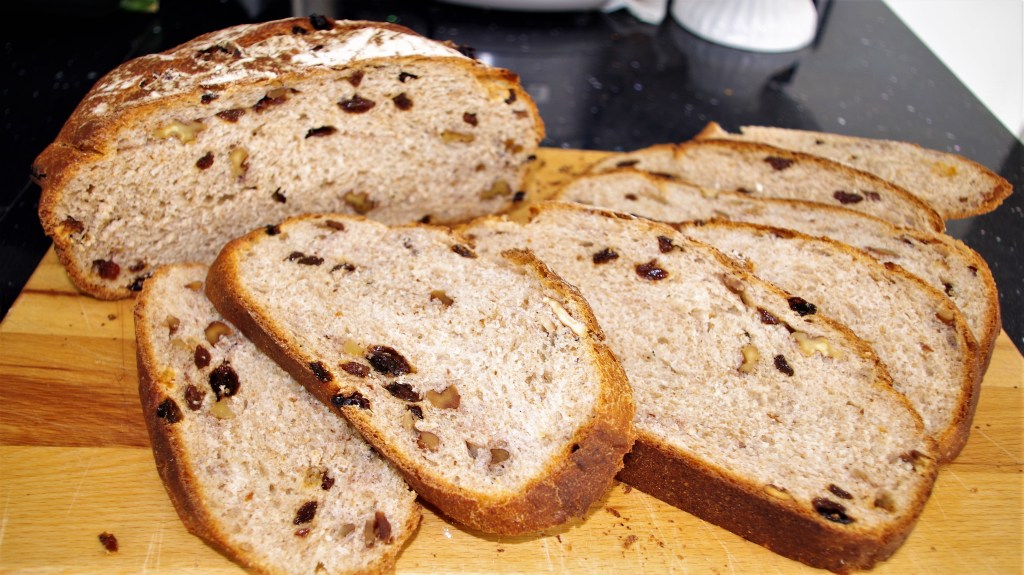
I’ve got a bit hooked on sweet bread for breakfast, usually with cream cheese and marmalade or, more indulgently, mascarpone and McKay’s Ginger preserve. If you also have an “early morning sweet tooth” you’ve got to give this combination a try. OK, back to bread. When I’d almost finished off my lovely Chocolate, Orange & Cranberry Soda Bread I wanted to get a replacement breakfast bake in the oven ASAP. It could have been another super quick soda bread, but instead I opted for this slightly longer, but tasty bake.
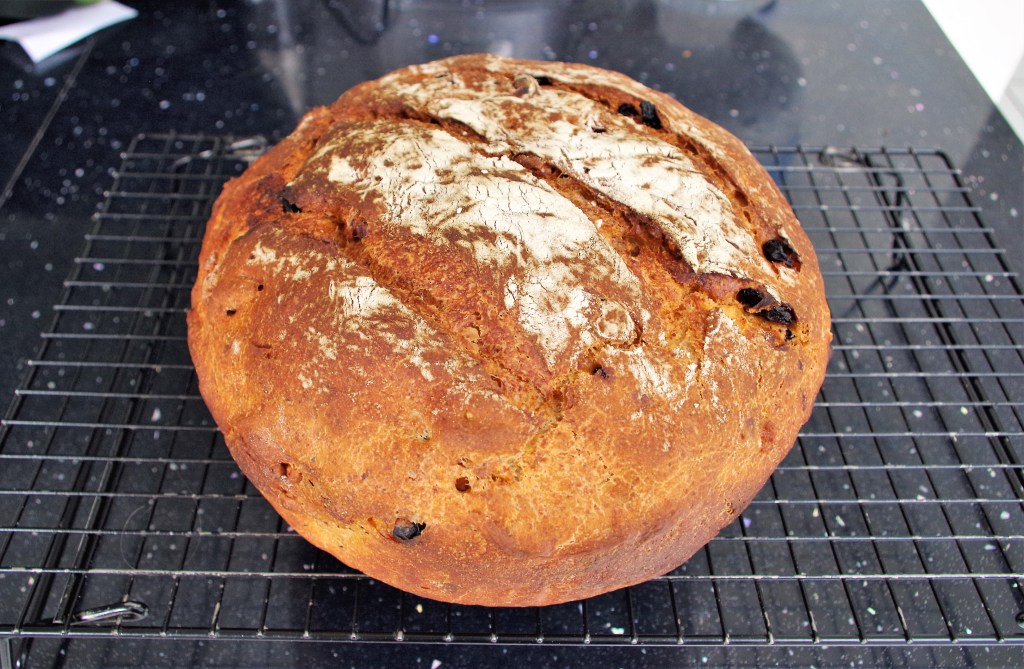
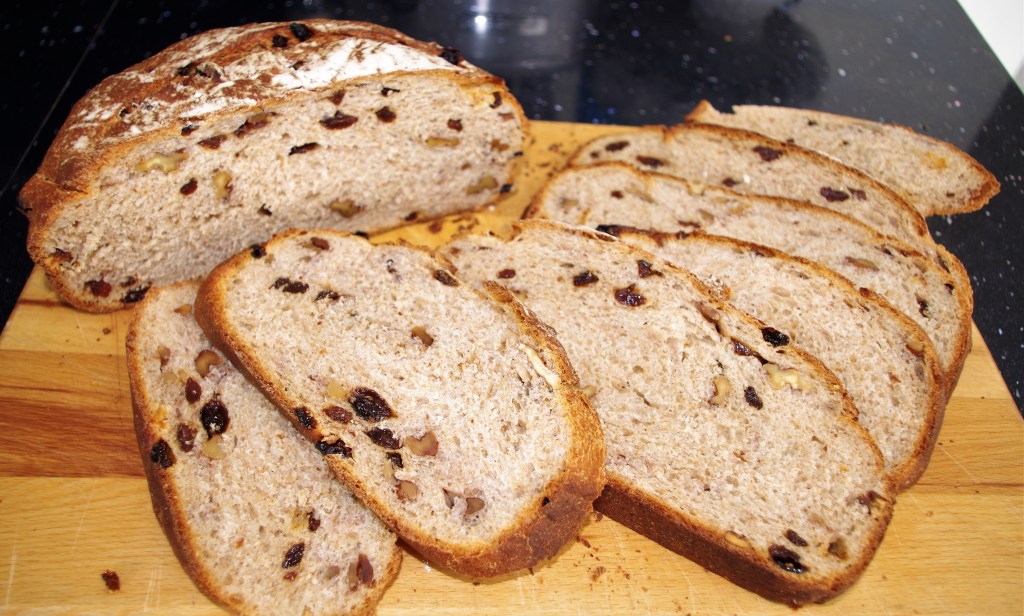

I’m assuming that most readers will already be bread makers of some experience so I’ve not given long-winded ultra detailed explanations. I’m also assuming that you will have certain items in your kitchen:
- 100g of sourdough starter – if not, simply add 50g flour + 50ml water
- A banneton – or use a lined, floured bowl
- A Dutch oven – a large lidded metal or glass casserole dish would be OK, but nowhere near as good as a cast iron Dutch oven. If you’re a keen bread baker – buy one.
OK, Ingredients first
Poolish/biga (Totalling 200g: half flour, half water + yeast)
NB I’m never sure what the difference is between a poolish and a biga, maybe it’s just the language.
- 100g sourdough starter + 50g wholemeal bread flour & 50ml water
OR (if not using a sourdough starter)
- 50g strong white flour + 50g wholemeal bread flour + 100ml water
- and 1g or 2g instant yeast
Dry elements
- 150g strong white flour
- 250g wholemeal bread flour
- 10g salt
Rising elements
- 50ml lukewarm water
- 7g – 10g instant yeast
- 25g sugar (or use 50g, but omit honey)
- 25g honey (or use 50g, but omit sugar)
Additional wet elements
- 200ml – 250ml lukewarm water
- 50g – 60g melted or very soft butter
Filling mixture
- About 100g walnuts, chopped or broken (toasted if possible)
- About 100g raisins
What you do with it all
1. Mix the “poolish/biga”, ideally the day before baking.
2. Mix the “dry elements” – set aside
3. Mix the “rising elements” – set aside until frothy
4. Combine the “additional wet elements” with the “rising elements” and mix well.
5. Pour the wet mixture into the dry and mix and form into a dough. Add more water if required.
6. Knead well.
7. Put into a lightly oiled bowl, cover and leave to rise.
8. Meanwhile roast the walnuts.
9. Tip the risen dough out onto a lightly floured surface and spread it out.
10. Distribute about half of the “Filling mixture”, over the dough and roll it together. Flatten out again then repeat with the rest of the filling..
11. Bring into a tight ball. Flour it well and invert into either in a banneton or a lined and floured bowl. Cover and leave to prove again.
12. When it has risen, lift into a cold Dutch oven and cut slashes. (or onto a baking tray/stone.)
13. Put the cover on the Dutch oven and place into main oven.
14. Bake at 220°C / Fan 200°C / 425°F / Gas 7 for 50 minutes. Remove the Dutch oven lid and bake for a further 10 minutes.
15. Then all the normal post bake stuff – tapping, listening, wire racking, resisting cutting or eating too early etcetera.
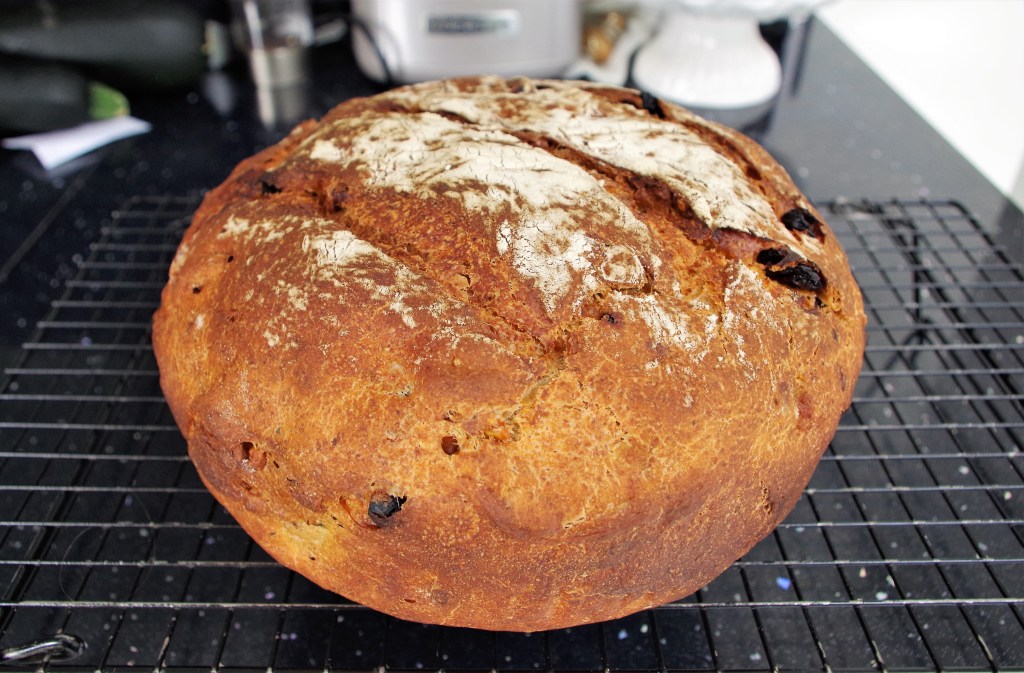
OK, if you got this far, well done. And even more congratulations if you actually made the loaf. You might be thinking I’ve over complicated everything and you’re probably right. (Feel free to make up your own simplified version.) I just love playing around with ingredients and processes. Maybe, never having taken Chemistry “O” level (yes, well before GCSEs), I now enjoy the alchemy of it all. That coupled with my anti-establishment attitude = recipes like this one. I’m not apologising, just explaining, as much for my own sake as anybody elses.
I hope you’ll be here again on my site and not give up on me completely. For lots of other recipes, including some a little more conventionally presented, go to https://retiredblokeonfoodnstuff.com/
 Retired Bloke on Food n stuff